WEMIHS had just completed two widely recognised programmes, the Sustainable Livelihoods Program and the Comprehensive Early Childhood Development Program in Kitui, when three key funding partners changed their focus.
The shock raised hard questions about our future and shaped our Strategic Plan 2017-2024, which made our own resilience a key strategy.
Now determined to overcome funding shocks and drawing on the sustainable livelihoods approach we know well, we asked: what resources do we have? Staff named several. One, mentioned reluctantly, was a pool of stagnant water at our office. What use could a mosquito breeding ground be? Through positive enquiry, we found it could be an asset. We also wanted an intervention for the community we serve, one that gives farmers practical and technical support, not only advice.
Our Gatuanyaga facility started with grow-out ponds, and they did well. Demand for fish stayed high even during Covid, and neighbours wanted to farm fish too. But quality fingerlings, the foundation of every fish farm, were hard to find and quality never assured. This got WEMIHS thinking about a hatchery.
In 2020 we established a hatchery to close this gap. Producing catfish and tilapia fingerlings within the county lowers transport costs, reduces the number of young fish lost in transit, and helps spread inland fish farming to more communities.
Our hatchery is fully licensed with a capacity to produce 40,000 mono-sex fingerlings per cycle, and is highly recommended by the Sagana Fisheries Research Institute and the Department of Fisheries in Kiambu.
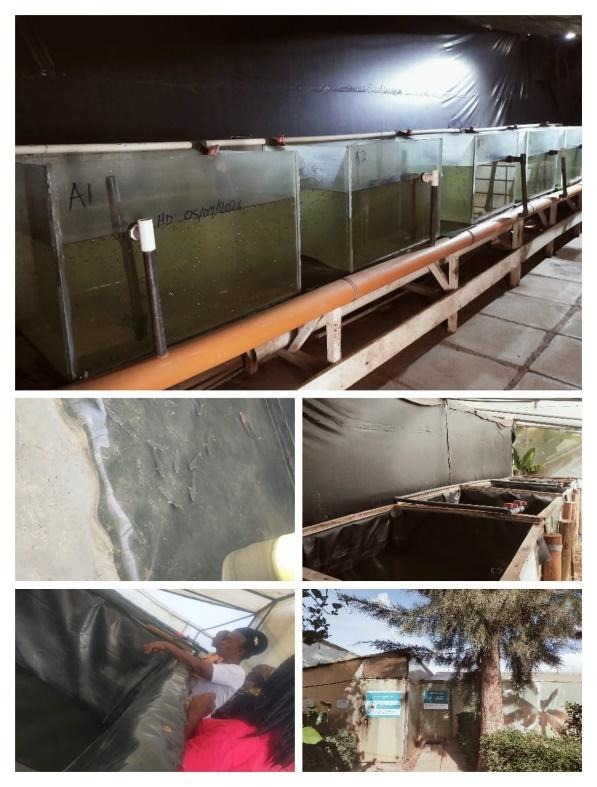
The hatchery serves a growing number of fish farmers from far and wide. Since opening, it has sold 119,410 fingerlings to 500 farmers in seven counties: Kiambu (260 farmers, 52%), Muranga (85, 17%), Machakos (65, 13%), Embu (35, 7%), Meru (25, 5%), Kitui (20, 4%) and Nairobi (10, 2%). It also runs a demonstration farm that county and national bodies look to as a point of reference. Farmers stock very different numbers of fish. Small-scale farmers keep fewer than 1,000, medium-scale farmers keep between 1,000 and 4,000, while large-scale farmers keep 5,000 or more.
Our support goes beyond selling fingerlings: we train farmers and provide farm visit, and we match our advice to the size of each one. Farmers learn through training, and forums where they troubleshoot production and market problems together. We have trained 352 farmers at the WEMIHS Fish Farm and made 141 farm visits at farmers’ request to give technical support on their own ponds. That is why our support goes beyond selling fingerlings. About 1,500 people benefit from better household food security. We have done this without donor funding so far.
The centre is a community hands-on learning hub that bridges research, policy and practice, with a focus on women and youth. We pilot aquaculture techniques and give feedback to partners such as the Sagana Fisheries Research Institute. The farm supports the County Government Aquaculture Business Development Programme (ABDP) and the national climate adaptation and Blue Economy agenda.
Feed is the biggest cost in fish farming, and most of it is imported and hard to access. Hence, our local fish feed making initiatives i.e. black soldier fly (BSF) and azolla units, focus on helping farmers cut on cost. We train farmers to use the alternative feeds.
WEMIHS’ aquaculture initiative demonstrates how fish farming can contribute to household well-being and climate-resilient livelihoods. By improving access to nutritious fish, the initiative supports better diets for children and strengthens household food security. At the same time, it creates opportunities for women and youth to participate in fish production and related value chains, generating income and strengthening economic resilience. Beyond producing fish, the initiative seeks to build healthier families, more sustainable livelihoods and communities better equipped to withstand economic and climate-related shocks.
In a dry landscape, the hatchery shows how water that would otherwise go unused can power climate-smart food production. As unpredictable weather continues to hurt rain-fed crops, fish farming gives rural families another source of income. Combined with crop growing, it supplies protein and micronutrients even during drought or crop failure. 70% of vulnerable rural households attest that selling of fish has indeed been an alternative source of income even during crop failure.
- Since my father was among the first people to start fish farming in our area, I have learnt as much as I can and practised on my own farm some Kilometres away from his. I receive people coming to see, learn and buy fish. I’m realizing the viability of fish farming. If there is an immediate issue like a child’s school fee, I can quickly scoop several kilograms, take them to Ruiru market and get my money. Fish is also a good alternative protein with many health benefits for me and my family.” Stanley Kamau, Project Beneficiary, Gatundu North.
- WEMIHS is a true centre of excellence. It is where farmers come to learn, where learners gain real hands-on experience, and where quality fingerlings are always available. When visitors ask me to show them a good hatchery in the county, WEMIHS is where I take them.” Olive Theuri, Director, Fisheries Dept, Kiambu County.
What began with a pool of water is evolving into a vision for a sustainable aquaculture enterprise that strengthens WEMIHS’ organizational resilience while improving farmers’ livelihoods and household food security. Looking ahead, WEMIHS aims to build an economically viable aquaculture model that creates opportunities for farmers, promotes affordable and sustainable fish production, and generates resources to support the organization’s long-term sustainability.
Partnerships and innovation will be central to realizing this vision. Recently, WEMIHS hosted the WorldFish team for a knowledge-sharing visit focused on aquaculture nutrition, reducing fish production costs, and exploring locally available feed ingredients such as Black Soldier Fly (BSF) larvae and soybeans. Such engagements provide opportunities to connect research, innovation, and practical farming experience, laying the groundwork for an aquaculture enterprise that benefits both WEMIHS and the growing network of farmers it serves.
In 2017 we found water where we wanted to build an office. Today that water supports a hatchery with 500 farmers and young farmers like Stanley are building something of their own.